| Active Ingredient | CANAGLIFLOZIN |
|---|
| Drug Name | FDA Application No. | Company | Dosage Form;Route | Strength | RLD Strength | Original Approval or Tentative Approval Date |
Exclusivity Expiration (NCE) |
Exclusivity Expiration (ODE) |
Chemical Type |
Review Classification |
Marketing Status |
TE Code |
|---|---|---|---|---|---|---|---|---|---|---|---|---|
| INVOKANA | (NDA 204042) | JANSSEN PHARMS | TABLET;ORAL | 100MG, 300MG | 300MG | March 29, 2013 | March 29, 2018 | - | 1 New molecular entity (NME) | S Standard review drug | Prescription | None |
| Parameters | Details |
|---|---|
| Structural Formula |
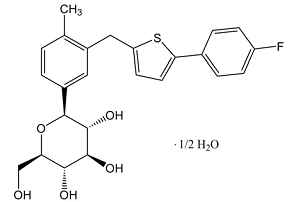 |
| Chemical Name | (1S)-1,5-anhydro-1-[3-[[5-(4-fluorophenyl)-2-thienyl]methyl]-4-methylphenyl]-D-glucitol hemihydrate |
| CAS No | 842133-18-0 |
| Molecular Formula | C24H25FO5S•1/2 H2O |
| Molecular Weight | 453.53 |
| Appearance | white to off-white powder |
| Solubility | practically insoluble in aqueous media from pH 1.1 to 12.9 and freely soluble in ethanol |
| Water Solubility | 0.0045 mg/mL (Predicted) |
| Polymorphism | Polymorphism has been observed for canagliflozin: the manufactured form I is a hemihydrate, and an unstable amorphous Form II. Form I is consistently produced by the proposed commercial synthesis process. As the manufacturing process consists of several recrystallization steps and polymorphic form II is amorphous it is accepted not to implement XRD test to the specification of the active substance. |
| pKa (Strongest Acidic) | 12.57 (Predicted) |
| pKa (Strongest Basic) | (Predicted) -3 |
| Log P | 3.09 |
| Identification | IR, UV |
| Degradation | The active substance is stable at high temperature and humidity and degrades moderately under basic and peroxide conditions. |
| Hygroscopic | non-hygroscopic |
| Photostability study | Canagliflozin is unstable under photolytic and radical oxidation conditions. |
| Melting Point | - |
| BCS Class | IV |
| Manufacture of API | Canagliflozin is manufactured by one source and is synthesized in four main synthetic steps plus two purification steps using well defined starting materials with acceptable specifications. The five isolations by crystallization in combination with the design of the manufacturing process result in a process with a high purifying capability. Adequate in-process controls are applied during the synthesis. The specifications and control methods for intermediate products, starting materials and reagents have been presented. The manufacturing process yields one diastereoisomer of the active substance. It is not necessary to perform a test for chiral purity on canagliflozin as the impurity is controlled by the general analytical method for impurities. |
| Parameters | Details |
|---|---|
| Indications and Usage | INVOKANA (canagliflozin) is indicated as an adjunct to diet and exercise to improve glycemic control in adults with type 2 diabetes mellitus. Limitation of Use:INVOKANA is not recommended in patients with type 1 diabetes mellitus or for the treatment of diabetic ketoacidosis. |
| Dosage and Administration | The recommended starting dose of INVOKANA (canagliflozin) is 100 mg once daily, taken before the first meal of the day. In patients tolerating INVOKANA 100 mg once daily who have an eGFR of 60 mL/min/1.73 m2 or greater and require additional glycemic control, the dose can be increased to 300 mg once daily. In patients with volume depletion, correcting this condition prior to initiation of INVOKANA is recommended |
| Mechanism of action | Sodium-glucose co-transporter 2 (SGLT2), expressed in the proximal renal tubules, is responsible for the majority of the reabsorption of filtered glucose from the tubular lumen. Canagliflozin is an inhibitor of SGLT2. By inhibiting SGLT2, canagliflozin reduces reabsorption of filtered glucose and lowers the renal threshold for glucose (RTG), and thereby increases urinary glucose excretion (UGE). |
| Absorption | The mean absolute oral bioavailability of canagliflozin is approximately 65%. |
| Food Effect | Co-administration of a high-fat meal with canagliflozin had no effect on the pharmacokinetics of canagliflozin; therefore, INVOKANA may be taken with or without food. However, based on the potential to reduce postprandial plasma glucose excursions due to delayed intestinal glucose absorption, it is recommended that INVOKANA be taken before the first meal of the day. |
| Distribution | The mean steady-state volume of distribution of canagliflozin following a single intravenous infusion in healthy subjects was 119 L, suggesting extensive tissue distribution. Canagliflozin is extensively bound to proteins in plasma (99%), mainly to albumin. Protein binding is independent of canagliflozin plasma concentrations. Plasma protein binding is not meaningfully altered in patients with renal or hepatic impairment. |
| Metabolism | O-glucuronidation is the major metabolic elimination pathway for canagliflozin, which is mainly glucuronidated by UGT1A9 and UGT2B4 to two inactive O-glucuronide metabolites. CYP3A4-mediated (oxidative) metabolism of canagliflozin is minimal (approximately 7%) in humans. |
| Elimination |
Following administration of a single oral [14C] canagliflozin dose to healthy subjects, 41.5%, 7.0%, and 3.2% of the administered radioactive dose was recovered in feces as canagliflozin, a hydroxylated metabolite, and an O-glucuronide metabolite, respectively. Enterohepatic circulation of canagliflozin was negligible. Approximately 33% of the administered radioactive dose was excreted in urine, mainly as O-glucuronide metabolites (30.5%). Less than 1% of the dose was excreted as unchanged canagliflozin in urine. Renal clearance of canagliflozin 100 mg and 300 mg doses ranged from 1.30 to 1.55 mL/min. Mean systemic clearance of canagliflozin was approximately 192 mL/min in healthy subjects following intravenous administration. |
| Peak plasma time (Tmax) | 1 to 2 hours |
| Half life | The apparent terminal half-life (t1/2) was 10.6 hours and 13.1 hours for the 100 mg and 300 mg doses, respectively. |
| Bioavailability | 0.65 |
| Age, gender |
Based on the population PK analysis with data collected from 1526 subjects, age, body mass index (BMI)/weight, gender, and race do not have a clinically meaningful effect on the pharmacokinetics of canagliflozin. Studies characterizing the pharmacokinetics of canagliflozin in pediatric patients have not been conducted. |
| DMF | Status | Type | Submit Date | Holder |
|---|---|---|---|---|
| 29434 | A | II | June 10, 2015 | BEIJING HUIKANG BOYUAN CHEMICAL TECH CO LTD |
| 29496 | A | II | June 30, 2015 | MSN LIFE SCIENCES PRIVATE LTD |
| 29867 | A | II | October 20, 2015 | MSN LIFE SCIENCES PRIVATE LTD |
| 30366 | A | II | December 31, 2015 | SHANGHAI DESANO CHEMICAL PHARMACEUTICAL CO LTD |
| 30449 | A | II | April 15, 2016 | LUPIN LTD |
| 30753 | A | II | September 9, 2016 | MACLEODS PHARMACEUTICALS LTD (CANAGLIFLOZIN) |
| 30771 | A | II | August 30, 2016 | MYLAN LABORATORIES LTD (CANAGLIFLOZIN) |
| 30853 | A | II | August 19, 2016 | CHONGQING PHARMACEUTICAL RESEARCH INSTITUTE CO LTD (CANAGLIFLOZIN MONOHYDRATE) |
| 30879 | A | II | September 20, 2016 | ZHEJIANG HUAHAI PHARMACEUTICAL CO LTD |
| 30941 | A | II | September 16, 2016 | ALKEM LABORATORIES LTD (CANAGLIFLOZIN) |
| 30951 | A | II | October 21, 2016 | INDOCO REMEDIES LTD (CANAGLIFLOZIN) |
| 30964 | A | II | September 28, 2016 | AUROBINDO PHARMA LTD (CANAGLIFLOZIN) |
| 31025 | A | II | September 30, 2016 | DR REDDYS LABORATORIES LTD (CANAGLIFLOZIN) |
| Parameters | Details | ||
|---|---|---|---|
| Strength | 100MG | 300MG | |
| Excipients used | Croscarmellose sodium (12 mg), hydroxypropyl cellulose (6 mg), lactose anhydrous(39.26 mg), magnesium stearate (1.48 mg), and microcrystalline cellulose (39.26 mg) | Croscarmellose sodium (36 mg), hydroxypropyl cellulose (18 mg), lactose anhydrous (117.78 mg), magnesium stearate (4.44 mg), and microcrystalline cellulose (117.78 mg) | |
| Composition of coating material | Macrogol (3350)(20.2%), polyvinyl alcohol (40%), talc (14.8%), and titanium dioxide (E171) (24.25 %), iron oxide yellow (E172) (0.75%) (Opadry II 85F92209) Yellow (Coating weight 8 mg/tablets) | Macrogol (3350) (20.2 %), polyvinyl alcohol (40%), talc (14.8%), and titanium dioxide (E171) (25%) (Opadry II 85F18422) white (Coating weight 18 mg/tablets) | |
| Composition of caspule shell | - | ||
| Pharmaceutical Development |
The finished product is 100 mg or 300 mg film-coated tablets manufactured by fluid-bed granulation. Both strengths are manufactured from a common granulation blend. The film-coated tablets are capsule-shaped, film-coated with different colours for each strength and debossed for identification. The product is packed in PVC/Al blisters. The compositions of the Opadry mixes were presented. Design of experiments was used to evaluate the influence of particle size, filler ratio, disintegrant level and binder level, as well as lubricant level and blend time. No design space was claimed. |
||
| Manufacture of the product |
The manufacturing process consists of eight main steps: preparation of dry ingredients, preparation of the binder solution, preparation of the granulation, sieving and final blending, compression, preparation of the film-coating suspension, film-coating of the tablets and packaging. The process is considered to be a standard manufacturing process. |
||
| Tablet / Capsule Image |
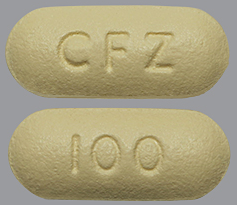
|
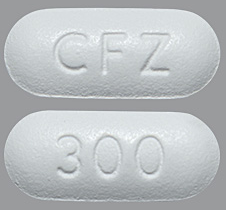
|
|
| Appearance | yellow, capsule-shaped, film-coated tablets with “CFZ” on one side and “100” on the other side | white, capsule-shaped, film-coated tablets with “CFZ” on one side and “300” on the other side | |
| Imprint code / Engraving / Debossment | "CFZ” on one side and “100” on the other side | "CFZ” on one side and “300” on the other side | |
| Score | no score | no score | |
| Color | yellow | white | |
| Shape | capsule | capsule | |
| Dimension | 11mm | 17mm | |
| Mfg by | Janssen Pharmaceuticals, Inc. (US, EU) | ||
| Mfg for | Janssen Pharmaceuticals, Inc. (US) | ||
| Marketed by | Janssen Pharmaceuticals, Inc.(US, EU) | ||
| Distributed by | - | ||
| Application No. | Prod No | Patent No | Patent Expiration | Drug Substance Claim | Drug Product Claim | Patent Use Code | Delist Requested | Link |
|---|---|---|---|---|---|---|---|---|
| N204042 | 1 | 7943582 | February 26, 2029 | Y | Y | U - 493 | - | Download |
| N204042 | 1 | 7943788 | July 14, 2027 | Y | Y | - | - | Download |
| N204042 | 1 | 8222219 | July 30, 2024 | - | - | U - 493 | - | Download |
| N204042 | 1 | 8513202 | December 3, 2027 | Y | Y | U - 493 | - | Download |
| USP Apparatus | Speed (RPMs) | Medium | Volume (mL) | Recommended Sampling Times (minutes) | Date Updated |
|---|---|---|---|---|---|
| II (Paddle) | 75 | 0.75 % sodium lauryl sulfate (SLS) in water | 600 | 5, 10, 15, 20 and 30 | June 2, 2016 |
| Label | Link |
|---|---|
| FDA label | Download |
| FDA chemistry review | Download |
| FDA Pharmacology Review(s) | Download |
| FDA Clinical Pharmacology Biopharmaceutics Review(s) | Download |
| FDA BE Recommendation | Download |
| European Public Assessment Report | Download |
| Territory | Brand name / Generic company name | Link |
|---|---|---|
| Canada | INVOKANA | |
| EU | INVOKANA | Download |
| Portugal (EU) | BLUEPHARMA - INDUSTRIA FARMACEUTICA, S.A (Generic) | |
| UK | INVOKANA | Download |
| US | INVOKANA | Download |
| - |
| www.accessdata.fda.gov, www.drugbank.ca, www.ema.europa.eu, www.medicines.org.uk, dailymed.nlm.nih.gov |